Episode 14 · 19 March 2026 · 51 min
Sharing Photos of Kids on Social Media
with Lisa Ventura MBE, Cyber security expert
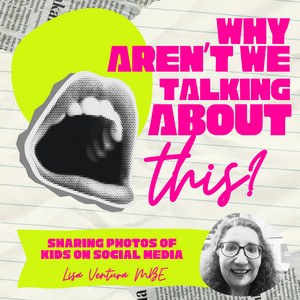
We're creating digital histories for our children before they're old enough to decide whether they want one.
Cyber security expert Lisa Ventura MBE explores what happens to children's images after they're shared online, how little control we may have over where they end up and the uncomfortable question underneath it all: who gets to decide which parts of a child's life become public?
Core themes explored
- What happens to children's images after they're shared online
- How little control we may have over where they end up
- The digital identity we create for children
- Who gets to decide which parts of a child's life become public
TranscriptRead +
Carly OsmanSo I going kick off by saying, welcome, Lisa. I'm really looking forward to this conversation today because it's I'm coming from a place of personal interest. I have an eight-year-old child, but I've also... I'm getting concerned about what I'm seeing, what's come out in the Epstein files, coercive control, all of it. And I basically want to protect my family. So this is being done for selfish reasons, because you are an expert in this space, but I'd love to first, if before I dive in, if you can tell me a little bit about yourself.
Lisa Ventura MBESure. Absolutely. Thank you so much for having me as a guest today. So my name's Lisa. I'm the founder of the AI and Cybersecurity Association, which I set up to look at the safe, secure, responsible and ethical use of AI. But within all of that, I also do a lot of awareness raising work around online safety and in particular to some of these things that we've been seeing recently, especially with the use of of images in children, about covering those images up, et cetera. And like you say, as a parent, you want to ensure that those those images and what you're you're sharing is as safe as possible.
Carly OsmanSo can we start there with the big question, how safe are the images of children that we post on social media?
Lisa Ventura MBEYeah. Okay, on this one, I'm actually going to be quite direct about it. Despite having all the privacy controls at our disposal, they are not, and nothing is 100% safe. And I think we've been sold a little bit of a fantasy around digital safety that actually doesn't really exist because the moment you post and an image, any image online, you use you you lose control of of that image. And I think here what matters more is that we've normalized something that if you were to describe it to somebody 30 years ago, it would actually sound quite dystopian back then. So by that, I mean things like we're creating comprehensive visual databases of children's entire lives. And that goes as far as their locations, their routines, their vulnerabilities. And that data is then almost sort of being handed to those corporations whose business model is to monetize that attention. So to the real question for me is isn't about you know how safe are those images. It's why did we ever think that doing this yeah was normal and how did we allow it to become part of our normal day-to-day psyche?
Carly OsmanThat's really, and you're right, we're essentially saying, this is how my child this is what my child likes, what he doesn't like.
Lisa Ventura MBEYeah.
Carly OsmanThis is the school he goes to.
Carly OsmanThis is the routine. This is how he behaved and reacted into that situation. There's no real privacy anymore, is there? Because we're showing the highlight reel, the low-right reel.
Lisa Ventura MBEYeah.
Carly OsmanOften when you're sharing something negative about your child, it' it's a response of their reaction to something. It was funny or this. We're creating, I suppose, digital footprints, aren't we?
Lisa Ventura MBEWe are, and there's a lot of risks around that on you know quite a few different levels. So firstly, there's data harvesting. because as you rightly say, every image you upload is then often analyzed by AI, and that could be anything from facial recognition to location metadata to object detection. And, you know, as as you just said, even things like you're sharing a photo of your child on their first day at school and they're in their uniform and you're really excited to do it. I mean, I i know I would be yeah exactly the same. I would be so excited to do it. But that uniform they're in that you could then potentially identify the school that they're going to and and so on. And Your child's face then can become part of a training data set that is often shared with or sold to governments, advertisers and surveillance companies. And also there's a degree of permanence. So that photo will follow your your child around. Universities and employers will look at social media. And yes, there's a level of degree that you can lock your profile down to friends only. But there's a lot of people. you know, out there that share photos and their account is completely public. Everybody can see everything that they post, every photo that they share, e etc. And that will follow your your child around. so You know, imagine being then, say, a teenager to 15 years old and someone finding photos that your parents posted of you, totally in innocence, but it's of you in nappies or posts that describe in great detail of how you were diagnosed with ADHD.
Carly OsmanYeah.
Lisa Ventura MBEAnd you know that means you have zero control over your own narrative. And I've had this yeah my myself, and I'll come onto that a little bit later on. And thirdly, this is something that worries me a lot, and it's AI-enabled abuse. So there are openly available tools that can take a child's face and an innocent playground photo, and it can place it in sexualised content. And we've probably heard all the stuff about Grok, the X tool that was being able to create those sexualised videos and and and and so on. And deep fakes used to require quite yeah know deep pardon the public expertise. But now there are apps that just do this instantly. And the source material is often our Instagram feeds. And there's also behavioral predictability. So as we said earlier, when we document a child's school, routines and emotional vulnerabilities, you're creating a handbook essentially for that manipulation. for anyone that might want to exploit that child in in in future
Carly OsmanThat absolutely, all of that absolutely terrifies me, especially the pulling of the child's image for sexualised situations. But surely if I just stick an emoji over the child's face or cover the logo, that can't happen, can I? Because I'm i'm protecting the image. Yeah.
Lisa Ventura MBEThere's a little bit of a myth around this and even celebrities, for example, like Prince Harry and Meghan Markle have famously shared photos on a trip to Disney World where they've put emojis over the faces of their children, Lily, Bertrand, Archie. And the problem with that is on a surface level, it does look like you're hiding the the child's face with that emoji. But again, There are AI tools and tools out there that can remove that emoji and then essentially from whatever information is out there in the public domain, it could potentially then produce what it believes that child to look to to look like.
Carly OsmanThank
Lisa Ventura MBESo there there really isn't you know anything in terms of full privacy. that's going to protect those those images. And even when you those images are shared with emojis, they could fall into the hands of cyber criminals or bad actors that could then essentially use that software to remove the emojis and construct what the child might might look like. So it still doesn't give you that 100% degree of privacy.
Carly OsmanAnd we can only assume that these tools are going to get smarter and more sophisticated as time goes on.
Lisa Ventura MBEYeah.
Carly OsmanSo I suppose it's, I'll keep going.
Lisa Ventura MBEAbsolutely.
Carly OsmanI suppose it's, it's, it's going, we don't, we, so the, probably the best thing you can do is avoid posting full stop.
Lisa Ventura MBEIt It is, but equally, you know, everybody wants to do it. Everybody wants to, you know, share those milestones and and share things with, you know, family and stuff as as well. so I always yeah say say as as well, even when you're sharing in platforms, for example, WhatsApp or private messaging apps, these end-to-end encrypted platforms, they're actually quite different from the way you used to post on your, say, Facebook account or Instagram. The company can't see your your content and that matters. But it often doesn't solve the kind the sort of the the issues around this, because sending a photo to your mum on WhatsApp is a contained intentional act. But say you sent it to you know a family group. and that included, say, up to 15 or more people, some of whom might be able to screenshot that or have insecure devices. So your attack surface, all the risks will then start to multiply. So I'm absolutely not saying, you know don't share. you know everything, but have an informed risk. So yeah look at who might screenshot it, who might have those devices that aren't quite as as secure. And look at it from the point of view that every share should be conscious or or minimal, and the platform matters less than the actual yeah practice of it. So always think think of things like, are you being intentional with what you're sharing? Are you considering your child's dignity or even the consent and ethics around it? Or are you just using as what you consider to be a safer app like WhatsApp that has that end-to-end encryption to do the same thing that you would do perhaps on on Instagram? So yeah just think about that sharing in a little bit more of a conscious way.
Carly OsmanI love the fact you've just mentioned the word consent and ethics, because this is what i really am very interested to explore. And one of the things that I'm exploring more with my child is consent and making sure that he has agency over over everything, where appropriate as for a child. But does a child really give you consent to share a photo online? have Do they have that cognitive understanding? Because from where I'm sitting, He's eight. He doesn't know the consequences if I'm going to share this funny photo of him. Or I suppose my question is, are we projecting consent on our children because we want to post something?
Lisa Ventura MBEYou're absolutely right with that because say, you know, an eight year old won't understand that a photo can exist forever or how it might affect them when they're say, you know, 14, 24, 34 beyond. and beyond and Even teenagers, are we genuinely giving them the freedom to say no or asking in a way that makes it clear that we expect a yes from them? and I think that as parents, i mean i'm yeah full disclosure, i'm I'm not a parent, but if I was, i think that we need to come at it from a couple of different angles. So explaining the full and yeah the full understanding when they're old enough to understand of the consequences, real freedom to say no, and the ability for them to withdraw that consent at any time. And we, as as as the parents, need to be the advocates for them for this and manage that from them. And that's why I go back to As parents, we really do need to think about everything that we're sharing online about our children, all those images, and then perhaps go us a sort of step further and then think, yeah this really, really cute you know photo
Carly OsmanYes.
Lisa Ventura MBEOf course it's cute to cute to us, it's yeah it's our its it's our child and of course we want to share it with the world. But how would we have felt? And I've got a, I think we'll come onto this in a bit because I've got a classic example with my own parents of having to have that that conversation with them. And because they are that sort of one or two generations removed from all this yeah know social media stuff, yeah they just don't get it at all and think that any photos that they've got of me are theirs to do with as they wish and they can just share them as much as they like on on Facebook or whatever medium. And, you know, I've had to have that conversation and I've had a lot of almost huge back about it, you know, in terms of how dare I tell them what to do and and so on. But they're photos of me and I want to be able to control that to a certain extent.
Carly OsmanI think this is a really, really important conversation that we need to have. And it's also, I want to have it in light of the Brooklyn Beckham saga that's come out.
Lisa Ventura MBEYeah.
Carly OsmanAnd I read and reread his announcement a number of times.
Lisa Ventura MBEYeah.
Carly OsmanAnd I want to read something that he actually said in it for my entire life. My parents have controlled narratives in the press about our family, the performative social media posts, family events, and inauthentic relationships have become a fixture of the life I was born into. When I read this, it sent alarm bells off. And to me, screamed of kind of coercive control. and and No one listening or I'm certainly never likely to achieve the levels of fame and notoriety as the Beckham family. But it did on a small scale kind of feel like what we're doing with our children where we've all in an attempt to, I suppose, give off the impression of the life we lived, used our children as essentially pawns to show up and and be like, this is the projection of the perfect life I'm living. What are your thoughts about all of this? And can you bring in your personal story into this too?
Lisa Ventura MBEYeah, absolutely. So like you, i saw the announcement from Brooklyn Beckham with great interest. And I have to say, I resonated with it so much, and especially with that what he said around all my life. i've had I've felt that I've had to sort of perform for social media. Another interesting thing he said, that love was given, but only if you performed or was in relation to how many clicks or likes or engagement that you got on social media. And when parents, I think, control the child's narrative to that extent, they're essentially saying to the world, the public version of you is mine to create. And that child doesn't get to decide which moments are private and which struggles perhaps might stay within the family. Everything is up for public consumption. consumption And This makes it quite insidious because it is often done with love and parents genuinely believe that they're celebrating that child. But intent doesn't erase impact because you can love someone and you can still violate their boundaries. And that's something I have had massive firsthand experience of. Every time I tried to set healthy the boundaries with my parents, it was pushed back and met with shouting, met with abuse, met with how dare you do this to us after all we've done for for you, because I think that they felt that I was put on this earth to serve them and serve their their every need. And what worries me most is how all of this shapes a child's sense of self. And I know this firsthand because I had absolutely no clue who I was or my own sense of self until I had my eyes opened to the amount of control that my parents had over my my life. And i was quite it was quite late in life. I was actually nearly 50 at the time. And it was quite eye-opening as to how much they were violating my boundaries. And yeah when those authentic moments become content or they're you know served up to you almost so to show people, look at me, aren't i you know aren't I amazing? Look at my amazing children. Look at yeah what they're doing. Look at the great life I've i've got on on social media. on social media It's really difficult then to develop that sense of private self because everything is is is up for and consumption. And I think, yes, we are doing this on a much smaller scale because social media runs on performance. We curate, we filter, and children become part of that performance, whether it's that perfectly styled first day of school photo I mentioned, or even the keeping it real tantrum post. I can't tell you how many times I've seen you know stuff shared by by parents because their children has had a full-blown meltdown or some sort of tantrum or so. And worse, it's when it's been diagnosed and that meltdown or that tantrum is a result of that child being autistic or having ADHD or or so on. It really makes me feel hugely uncomfortable because I think that child has probably just got to the end of their tether and that outward burst or tantrum or whatever you want to call it is the is is the result. So I really get quite ugh when I see things like like this. So as parents, I think, sorry, go on.
Carly OsmanI'm seeing this play out. I'm sorry, you go, Lisa.
Lisa Ventura MBEI was going to say, as as as parents, ask yourself some uncomfortable questions. Things like, am I sharing this to celebrate my child? or to present myself as a good parent? Would I post this anyway if I got no likes? Because if the answer's no, it's it's not about the child, it's all about you.
Carly OsmanI think that's a really interesting framing to look at it. And I'm actually seeing this play out at the moment. There's an influencer. whose daughter's just been diagnosed with ADHD and she's sharing everything. She's sharing the reactions with school, what she's doing, how the child reacted, what the classmates are saying. Nothing is private. And I...
Lisa Ventura MBE. Yep. Yep.
Carly OsmanFor me I just see it feel this is total violation of privacy and I can only imagine what in years to come when that child views the content and sees the mother going through oh it's so hard for me I'm I'm struggling with this and I'm sure it's done for the place of I want to be vulnerable I've got my followers I I want them to feel part of the journey and I'm serving them but you're doing it the detriment of your your child
Lisa Ventura MBEAbsolutely. And I see this firsthand. There's a particular person that actually has a a charity in terms of business and those are the neurodivergent. And that person parades their son, who's very severely autistic and has ADHD and so on, and posts every interaction, every tantrum, every meltdown, every you know little thing and it really makes me feel profoundly uncomfortable to the point that I've had to literally block and just you know mute this this person as as much as possible because I feel so, so sorry for that child and and as you say, heaven knows what that that child's going to make of it yeah much much later down the line. And you just going back on to my parents, They didn't have you know social media until yeah the last 10 years or so. And they weren't of that generation. But they controlled their narrative through storytelling. And it was only when I got to my late 40s and I realized what they were actually like, that their versions of me were different depending on who their audience yeah was. So there could be different versions of me with extended family, what achievements yeah were were celebrated by them, what struggles were reframed, even things like when I got my autism diagnosis. They could not quite accept that at all and went about it in a you know a very different different way of trying to explain it as, all to do with my yeah but my mental health and and so on, which is absolutely not true. And I internalised the fact that my authentic self wasn't acceptable for public consumption and only the edited version was. And that actually created a very profound disconnect between my internal experience and feelings and also how I sort of presented externally. So imagine that then being amplified tenfold when social media comes into into the mix, because it's not just occasional family gossip, but it's permanent digital records that are just yeah accessible to all and sundry or to the people that my parents accepted as Facebook friends.
Carly OsmanThanks.
Lisa Ventura MBEAnd even today, because of that, I still have to actively work to distinguish between the person I was told I was by my parents or the person that they projected to the world and the person I actually am. So for me, what happens to children who grow up with, you know, like Brooklyn, with every moment documented and curated by their parents, We don't know fully the answer to that yet, but I think we we'll yeah know find out as as time goes on.
Carly OsmanDo you think we're going to see a backlash over the next 5, 10, 15 years of children who have been brought up with their whole life broadcast on the internet?
Lisa Ventura MBEI think we're already starting slowly to see a bit of it, thanks to Brooklyn Beckham and that statement. yeah Since then, I've heard of you a lot of teenagers that are asking parents to delete photos or not share them online on social media. And young adults, especially those, like you say, of those influencers, they're discovering that their childhood was monetized often without their consent. And there are already things like yeah know therapy sessions, suits, et cetera, that are centered on this. But I think it's just going to get much worse because those sort of older children with comprehensive digital footprints, they're now only just reaching adulthood. So I think perhaps in 10 years time, we'll start seeing a lot more legal challenges around the right to privacy from birth and maybe even more young people suing parents for emotional distress and a generation that's deeply uncomfortable with being photographed. And relationships between parents and adult children that will be yeah forever damaged by this breach of trust. And I think that the children most at risk are those parents that share them they the most, like David and Victoria Beckham. And I think as well, we'll see it as one of the greatest ethical failures of our generation because we were so focused on documenting every moment that we forgot children are people with rights to privacy and dignity as well. And that's so important.
Carly OsmanThat's powerful. That's really, they are people, they are, they are humans with their own agency in their, their lives that they are yet to build.
Lisa Ventura MBEYeah.
Carly OsmanWe do not need to force narratives and and try and shape them.
Lisa Ventura MBEYeah.
Carly OsmanThe last thing I want to ask you, and it's something that I've been thinking about a lot, which is when I first came on social media and I was i around pre, pre Facebook. So when Facebook first came on the scene, It promised this world of connection and it was about staying connected, sharing our lives. but We've now turned it into this big open world where everything is on the table.
Lisa Ventura MBEYeah.
Carly OsmanEverything is expected to be out there. How do you recognize that? I suppose that, oh, the reconcile even that magic intent with what it's become.
Lisa Ventura MBEFor me, it's like anything that's out there that's used for good, there's always a way to use it for bad. And an analogy for that that I often use is, you know, nuclear power and energy on the surface. Can you imagine if we could harness that and use it to provide you know energy? but it was taken and used in such a bad way for the construction of nuclear weapons and so on And social media is is similar in that in in that respect, in that if we used it in the way it was created, which was to stay connected, you know, I'm in touch with cousins in the States, in Italy. I have friends because of Facebook and social media from all over the world. And no matter what time of of day or night it it is, I know that there are people that I know on online that I can reach out to and talk to if I need it or need a bit of extra support. And they're as far afield as you know Australia, States, to yeah all over all over the world. And one of my close friends very sadly passed away at the end of December. and He passed away suddenly. but I met him as a result of Facebook because we were in some some dog groups and he would post stuff about his dogs and I would about my dog Poppy and we got to chatting and commenting on each other's posts and it turned out he actually lived quite local to me.
Carly OsmanOh.
Lisa Ventura MBESo when his wife passed away a couple of years ago, i was there to sort of trying to help in terms of him navigating his grief. I spent quite a bit of time with him, did stuff with with him in terms of just trying to keep him a little bit more you know occupied and not so focused on that that that's to level of of grief. And then it was a real shock when he passed away at the end of December last last year. And I'm still navigating that because he became such a big part of my life and my husband's life as as well. So I think if we can use it in the way that it was originally intended to stay connected, it would be a wonderful thing. But as ever, it's been used by bad actors and monetised and used for bad. So I think we need to ask whether social media now is actually fulfilling that purpose of staying connected anymore or whether it's become something else entirely. And for me real connection doesn't need the broadcasting of my life to a gazillion people. It happens for me in those more private moments, those direct messages, video calls, or you know private things shared and face-to-face interactions, because I think we conflate with sharing our lives. with you that must be We must be documenting everything publicly, and that's not the same. So I'll leave this with children deserve to have private lives. And not every single moment that they have needs that audience. Some things can just be ours and be sacred and protected. And, you know, a final thing I'll say on this is social media promised us community. But what it gave us was an audience. And I do think our children are paying the price for that today.
Carly OsmanThank you, Lisa. Oh, you were amazing. You were, that was brilliant.